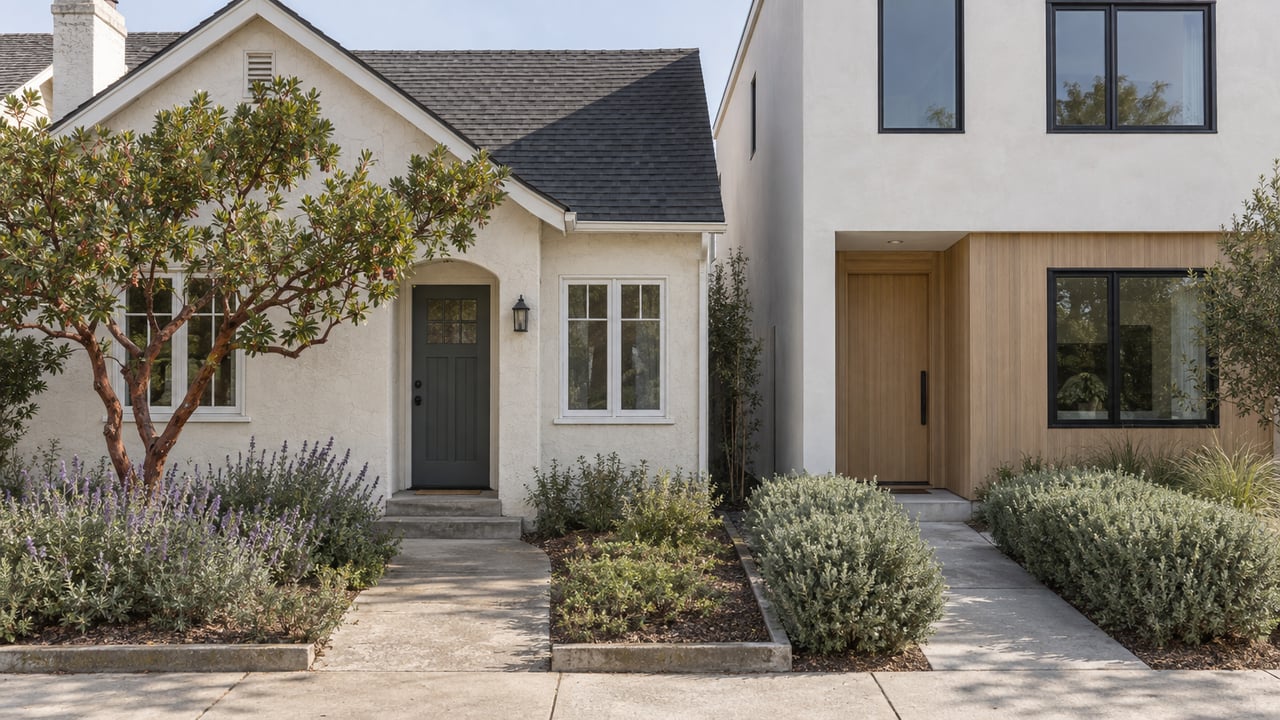
North and South Redondo Beach Are Converging on Price. They Aren't Converging on Anything Else.
October 1, 2026
October 1, 2026
A buyer scrolling listings in the 90277 zip code will eventually land on a pocket of homes carrying a Redondo Beach mailing address that has nothing to do with Redondo Beach. The Hollywood Riviera streets sit inside the City of Torrance, zoned for Torrance schools and served by Torrance municipal government, even though the envelope in the mailbox says otherwise. It is the kind of detail that never shows up in a portal search filter and only surfaces when someone asks the wrong question at the wrong stage of escrow.
That mismatch between what an address implies and what it actually delivers turns out to be a useful warning for the rest of Redondo Beach, because the same gap between appearance and substance is happening at the citywide level with price.
Split the city along its long-standing north-south line, roughly the 190th Street, Anita, Herondo, and Torrance Boulevard corridor that locals already use to separate the two halves, and something strange shows up in the most recent data. Over the three months ending in May 2026, North Redondo Beach (90278) posted a median sale price of $1.6 million. South Redondo Beach (90277) posted the same figure over the identical window: $1.6 million.
For a city where the coastal strip has historically commanded a real premium over the inland side, that is the kind of number that reads like the market has finally leveled out. It hasn't.
The median sale price is a single number standing in for a huge range of square footage, lot size, and building type. Pull the price-per-square-foot figure for the same three-month window and the two halves of the city stop looking like the same market at all.
| Metric (3 months ending May 2026) | North Redondo Beach (90278) | South Redondo Beach (90277) |
|---|---|---|
| Median sale price | $1.6 million | $1.6 million |
| Median price per square foot | $727 | $878 |
| Year-over-year change in $/sqft | down 9.13% | down 3.6% |
| Homes sold in May | 106 | 70 |
| Average days on market | 32 | 28 |
A dollar spent in North Redondo is buying roughly 21% more square footage than the same dollar spent in South Redondo. That gap has been there for a while and is not the interesting part. The interesting part is the direction each side is moving. North Redondo's price per square foot is falling nearly three times faster than South Redondo's. The median sale price converged. The trend lines underneath it are pulling apart.
The convergence makes more sense once you look at who is actually buying on each side of the line.
North Redondo's buyer pool leans heavily on proximity to employment. The zip code sits within commuting range of Northrop Grumman's Space Park campus on Marine Avenue and of SpaceX's facility in nearby Hawthorne, and aerospace and tech professionals show up disproportionately among recent buyers there. That buyer is typically optimizing for square footage, yard space, and school access at the most attainable price point the coastal South Bay offers. They are not paying for a view. They are paying for a commute and a floor plan.
South Redondo's buyer draws on a different motivation entirely. The premium there is tied to walkability to King Harbor, the Esplanade, and Riviera Village, and the buyer profile skews toward downsizers and second-home purchasers for whom a daily commute is irrelevant. That buyer is paying specifically for lifestyle proximity, and the data shows they are still willing to pay it even as the broader market softens. South Redondo's price per square foot has held up better precisely because its buyer isn't shopping on cost per square foot in the first place.
Two different sets of priorities producing two different rates of decline just happen to be landing on the same median dollar figure this spring. The matching median masks how differently the two buyer pools are responding to the market.
Part of what is dragging on price per square foot along the coast, even while medians hold, traces back to building type rather than location. Citywide, houses and condos in Redondo Beach have been telling opposite stories. In the first quarter of 2026, the median sale price for houses rose 6.4% year over year to $1.7 million. Condos moved the other way, falling 10.7% year over year to a $1.2 million median over the same quarter.
South Redondo's coastal blocks carry a much higher concentration of condo and HOA-governed buildings than North Redondo's flatter, more suburban-style lots. That composition matters right now because California's SB 326 required condominium associations to complete structural inspections of balconies, decks, and walkways by January 1, 2025, as LegalClarity explains, and those inspections have been surfacing deferred maintenance and reserve shortfalls in buildings up and down the coast. The City of Redondo Beach's own Community Development Department has published a compliance bulletin walking associations through the nine-year reinspection cycle and the requirement that inspectors notify code enforcement within 15 days of finding a hazard. A newer state requirement, effective this year, now obligates sellers to disclose those SB 326 inspection reports to buyers, as Nexova AI reports, which means a building's structural history is no longer something a buyer has to dig for. It shows up in the resale package.
None of this means coastal condos are a bad buy. A two-bedroom unit at 727 Esplanade sold in January 2026 for $2.4 million, a record for that building, proof that a well-maintained, view-forward property in a healthy association still commands top dollar. But the spread between a building with strong reserves and one with a pending assessment has widened, and that spread sits almost entirely on the South Redondo side of the map, because that is where the condo stock is concentrated.
None of this argues that one half of Redondo Beach is a better buy than the other. It argues that comparing them on median price alone tells you almost nothing useful.
A buyer choosing between a house in North Redondo and a condo in South Redondo isn't really choosing between two prices that happen to match. They're choosing between a larger floor plan next to an aerospace commute corridor and a smaller, walkable unit whose true cost depends heavily on the health of an HOA reserve account that may or may not have absorbed its SB 326 inspection yet.
A seller pricing a home in either zip code needs the same caution in reverse. Citing a citywide median, or even a same-zip median from six months ago, can misprice a listing in either direction depending on whether square footage or building type has shifted underneath that number since the comp was set.
And any buyer drawn specifically to the Redondo Beach brand, the schools, the municipal services, the address itself, needs to confirm which city and district a specific parcel actually sits in before treating the zip code as a promise. The Hollywood Riviera pocket is proof that the mailing address on a listing sheet is not always the jurisdiction attached to it.
The two halves of Redondo Beach met at the same number this spring. They got there while moving at different rates, for different reasons, carrying different risks. That is worth more to a buyer than the number itself.
Comparing a house in North Redondo against a condo in South Redondo, or trying to work out whether a specific HOA has actually cleared its SB 326 inspection, is exactly the kind of detail work Vertice Williams handles for South Bay buyers and sellers every day. Let's Make Your Move Happen.
This article is general information, not legal, tax or financial advice. Consult a qualified professional about your situation.
Stay up to date on the latest real estate trends.
As a trusted South Bay real estate expert, Vertice Williams is dedicated to helping buyers, sellers, and investors navigate every step of the process with confidence.
VERTICE WILLIAMS | CA DRE# 01938199
[email protected]
(310) 751-0327
CARMODY REAL ESTATE, INC. | CA DRE# 02283642
2450 Colorado Ave Ste 100 E Santa Monica CA 90404